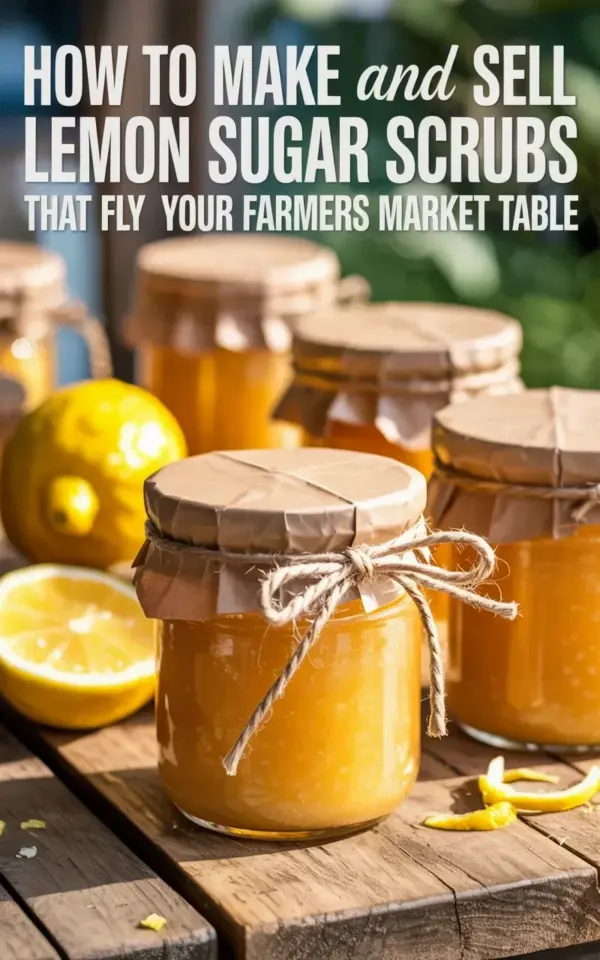
Last summer I loaded my car with fifty jars of lemon sugar scrub and drove to my local farmers market. I came home with exactly four jars left and a pocketful of cash. That moment convinced me this is one of the easiest products to make and sell, especially when you nail the packaging. Those little glass jars with kraft paper lids and a simple twine bow? They practically sell themselves. Fresh lemons scattered across your table seal the deal. Ready to make your own batch?
Why Lemon Sugar Scrub Sells So Well at Farmers Markets
People walk past a booth selling body scrubs and they stop. Not because the product is fancy. Because it smells like a real lemon, not a synthetic cleaner. And the texture? Gritty, oily, satisfying. I’ve had customers pick up a jar, unscrew the lid, take one sniff, and hand over cash without even asking the price. That’s the power of a simple, honest ingredient list.
At farmers markets shoppers want something they can see, touch, and smell. A jar of sugar scrub delivers all three. The orange-yellow color of the scrub against clear glass catches the light. The fresh lemon slices you place around the jars tell people “this was made in a real kitchen, not a factory.” Honestly, you don’t need a fancy display. A rustic wooden table, a few lemons, and those jars lined up in a row are enough.
Here’s the thing: competition at markets can be fierce. But lemon sugar scrub occupies a sweet spot. It’s a practical luxury. Not too expensive (I sell mine for $8 per 4-ounce jar), not too complicated. People buy one for themselves and two for gifts. That repeat purchase habit builds your customer base fast.
My Go-To DIY Lemon Sugar Scrub Recipe
Ok, so I’ve tried a dozen recipes. Some use too much oil (greasy mess). Some don’t have enough lemon zest (boring). This version hits the perfect balance. It’s a simple three-ingredient base plus one optional add-in.
- 1 cup granulated white sugar
- 1/3 cup fractionated coconut oil (or any light carrier oil – sweet almond works too)
- Zest of one large lemon (don’t skip this – it gives texture and a natural pop of yellow)
- 15-20 drops lemon essential oil (adjust to your nose – I like mine strong)
The method is laughably easy. Mix the sugar and lemon zest in a bowl. Pour in the oil. Add drops of essential oil. Stir until everything looks like damp sand. Spoon into jars. That’s it. No heat, no melting, no special equipment. You can whip up a batch of twenty jars in under thirty minutes.
A weird little detail: I always zest the lemon over the sugar bowl so the oils from the peel fall right in. That extra bit of fragrant zing makes a difference. Also, don’t use brown sugar. It looks pretty but the molasses makes the scrub sticky in a bad way. Stick with white granulated.
How to Package Your Scrubs with Rustic Kraft Paper Lids
Let’s talk about the lids because that’s what makes the photo happen. Those brown kraft paper circles tied with twine are not just cute. They signal handmade quality before anyone even opens the jar. Here’s my process.
I buy regular 4-ounce Mason jars with metal lids. But I don’t use the metal lids for display. Instead I cut circles of kraft paper (about 3.5 inches diameter) using a simple circle punch. Place the paper circle over the jar opening, then secure it with a piece of kitchen twine wrapped around the rim and tied with a bow. That’s it. Two seconds per jar.
One thing I learned the hard way: don’t tie the twine too tight or the paper rips. And leave a little slack so customers can sneak a sniff. That open-able top encourages people to lift the edge, smell the lemon, and commit to the purchase.
I also add a tiny handwritten label stuck to the front of the jar. A simple white sticker with “Lemon Sugar Scrub” in black ink. Nothing fancy. People love knowing it’s made by a real person, not printed in bulk.
Sourcing Supplies That Keep Your Costs Low
When you’re selling for $8 a jar, every penny counts. Here’s where I save and where I spend. Glass jars are cheapest in bulk from online restaurant supply stores. I get a case of 48 for about $20. Kraft paper comes from any craft store, one roll lasts forever. Twine? Dollar store spool, maybe $1.25.
Where I don’t skimp: the lemon essential oil. Cheap oils smell fake, and your customers will notice. I buy therapeutic-grade from a local herbal shop. It costs more upfront but the scent stays true in the jar for weeks. Coconut oil I use fractionated because it stays liquid at room temperature. Regular coconut oil solidifies and looks chunky. Not a great look for a smooth scrub.
And lemons. I buy a bag of organic lemons for the zest. The leftover lemon halves? I slice them and scatter them on the table for display. Zero waste, plus they make the whole booth smell incredible. One time a woman asked if she could buy the sliced lemons. I gave her one for free and she bought three jars.
Pricing Strategy and Display Tips for Your Market Table
I started at $6 per jar. That felt too cheap. $10 felt too expensive. $8 is the sweet spot. People think “that’s a good deal” without questioning the value. I also offer a deal: buy three for $20. Almost everyone takes that offer.
For your table, keep it simple. A wooden crate or an old cutting board works as a riser. Place jars in a neat row, but not perfectly straight. A little casual asymmetry looks more like a farm stand and less like a chain store. Scatter lemon slices and a few whole lemons around. Add a small sign (chalkboard style) with the price and ingredients list. I also put a tester jar out with a tiny spoon so people can touch the sugar scrub and smell it directly.
Pro tip: bring a small bowl of lemon slices on the side. When someone stops, hand them a slice and say “smell this, it’s the same lemon I use in the scrub.” That personal connection sells faster than any sign.
Business Tips I Wish I Knew Before My First Market
My first market I made forty jars. I packed them in a bin with no dividers. Fifteen minutes of bumpy driving turned five jars into oily sugar soup. Learn from me: pack jars upright in a cardboard box with crumpled newspaper between them. Or better yet, use a wine bottle carrier. Those six-slot cardboard holders fit 4-ounce round jars perfectly.
Also, bring change. You will get $20 bills for an $8 purchase. I carry a small cash bag with at least $40 in singles and fives. And set up an easy payment option like Venmo or Square. About a third of my sales last year were digital.
Another thing: price your jars clearly. Don’t make customers guess. I write “$8 each or 3 for $20” in big letters on a tent card. Honesty, I learned the hard way that shy customers will just walk past rather than ask the price. Make it obvious.
And sell the story. When someone picks up a jar, tell them you zested the lemons yourself that morning. That tiny human detail makes the product memorable. They’ll tell their friends. And that’s how you build a repeat customer base from one market day.
Rhetorical question here: does it really get any better than seeing your own jars lined up on a table, with a stack of cash in your apron pocket and the smell of lemon in the air? Not really.
Final Thoughts and a Little Push
This lemon sugar scrub project is low-cost, low-stress, and genuinely fun. It’s the kind of DIY that feels like a craft but pays like a business. Whether you sell three jars or fifty, the pride of watching someone choose your product over others is addictive. I still get a little buzz every time a customer says “this smells incredible” before I even hand them the jar.
So go ahead. Buy some sugar, grab a few lemons, and fill those little glass jars. Your farmers market table is waiting. And if you want a visual reminder, save this post for your market prep. Trust me, you’ll be glad you did when you see that row of golden scrub under the market tent.
#LemonSugarScrub #FarmersMarketSelling #HomemadeBathBody #DIYGifts #RusticPackaging
Leave a Comment