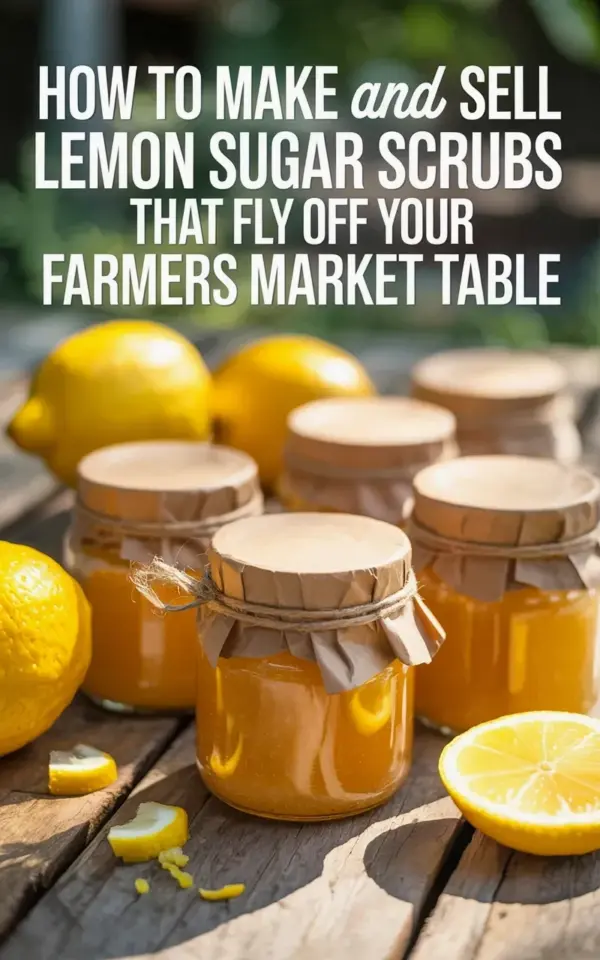
The rustic wooden table in that photo is exactly what customers picture when they think “local.” Little glass jars, brown kraft lids, twine, and that bright lemony yellow filling, it’s a handmade product that sells itself before you even say hello. The lemon sugar scrub is a farmers market staple for a reason, and honestly, it’s one of the easiest things you can make for your booth. I’ve seen these fly off tables more times than I can count.
Here’s the thing: you don’t need a commercial kitchen, a bunch of fancy equipment, or a chemistry degree to pull this off. You need sugar, oil, lemons, and a few hours. This guide is not just a recipe, it’s a collection of market-tested ideas on how to make, package, and price them so you actually turn a profit.
### The Basic Recipe for a Lemon Sugar Scrub That Works Every Time
Let’s get the foundation down first. Look, there are a million sugar scrub recipes online, but most of them are too oily or too dry. You want a texture that holds together slightly when you scoop it, but crumbles easily in your hand. That’s the sweet spot.
Start with a simple 2:1 ratio. Two parts white sugar to one part oil by volume. So, if you’re using a 2-cup measuring cup, that’s 2 cups of sugar and 1 cup of oil. For the oil, use something light. Sweet almond oil is a classic, but fractionated coconut oil is easier to find and often cheaper in bulk. Both work fine.
Mix in the zest of two lemons per batch. Not the juice, just the zest. Juice makes the sugar dissolve and the texture turns into a gritty sludge. Zest gives you that bright, fresh lemon aroma and a beautiful color. Add a few drops of lemon essential oil if you want the scent to last longer than a few days. That’s it. Mix, jar, cap, and done.
### Turning Your Scrubs into Farmhouse Gift Jars
You can buy simple mason jars, but the little jelly jars or glass spice jars with metal lids are way cuter for this. They look like something your grandma might have kept in her pantry. The photo shows exactly the look, kraft paper lids and twine. This is where the “curated” part comes in.
The kraft lid is easy to DIY. Trace the metal lid top onto some kraft paper, cut it out, and glue it on. Or, if you’re making a ton, look for pre-cut kraft labels that stick right over the original lid. I get mine from a local craft store, but online bulk suppliers have them too.
Finish it with a piece of twine tied around the neck of the jar. Add a tiny sprig of dried lavender or a cinnamon stick for a seasonal twist. Don’t overthink the design here. Minimalist is usually better, and it honestly reads as more rustic and authentic. Customers associate that simple look with a small, handmade batch, which is exactly what they want at a farmer’s market.
### Scent Variations and Custom Labels for Your Market Booth
If you only show up with plain lemon, you’re leaving money on the table. Lemon is the gateway scrub. It’s safe and universal, but you need a reason for people to buy two or three jars.
Consider these combo ideas for your batch list:
– **Lemon Lavender:** Add two drops of lavender essential oil per jar. This is a huge seller for stress relief.
– **Lemon Rosemary:** Gardeners and cooks love this one. It feels more like a kitchen item than a beauty product.
– **Lemon Sparkle:** Add a sprinkle of biodegradable glitter or dried calendula petals. These are great for gifting.
You can also play with the labels. If you made a lavender batch, write “Lemon Lavender Scrub” in messy handwriting on a small white label and stick it under the twine. This shows you’re curating small batches, not mass-producing an assembly line. It’s a small detail, but it matters to customers.
### Pricing and Packaging for Farmers Market Booth Tips
Pricing is where most home crafters mess up. They price their product for $8, and they sell out in an hour, then realize they only made $2 profit after jars, oil, and sugar. Not gonna lie, it hurts to see that happen.
Do the math on your materials. A 16-ounce jar will typically retail for around $12 to $15 if your costs are under $4. Go smaller if you need to keep the price lower. Smaller 4-ounce jars can sell for $5 each, which is perfect for a “try me” item. Always have a couple of sample jars open so people can smell and touch the scrub. This is a texture product. People want to feel the grit.
Here’s a quick checklist for your booth setup:
– Have a sign that clearly states the scent and price.
– Put small scoops or plastic spoons by the sample jars, nobody wants to stick their fingers in the product.
– Price in whole dollars to minimize change-making.
– Keep a few scrub jars in a cooler on hot days, oil can melt and look messy.
### Batching Them Out Quick, Production Tips for Homemade Products
Ok so you’ve got your table spot booked and you need 40 jars by Saturday. You can do this in one afternoon if you work smart. Don’t mix thirty individual bowls of scrub. That’s insane. Mix a giant batch in a large mixing bowl or a clean plastic bin.
It’s easiest to zest all your lemons first. Like, do a big pile of zest, then mix the oil and sugar in bulk. Once the mixture is consistent, you can scoop it into the jars. I use a cookie scoop for this. It keeps the jars cleaner and speeds everything up incredibly fast.
One weird thing I learned the hard way: you have to press the scrub down into the jar a little bit. If you just scoop it in loosely, the jar looks half empty and customers will complain. Press it down with a spoon or the back of your scoop until it’s packed tight, but not so hard that the oil separates. That packed jar looks fuller, heavier, and more valuable.
### Setting the Scene at the Market
When you’re at the market, don’t just place the jars flat on the table. Stack them, group them by scent, or put a few on a wooden cake stand to vary the height. The photo in this post shows them in a row on a rustic wooden table, but in real life, a little height variation catches the eye better.
Slice a lemon in half and leave it on the table near your jars. It sounds simple, but that fresh cut fruit smell wafting around your booth is a powerful trigger. It tells your nose, before your eyes even process it, that this is fresh. Put a bowl of the actual sugar scrub mixture down for people to sniff.
Place a few small jars near the edge of the table closest to the aisle. I noticed that if stuff is easy to grab and inspect, people are more likely to buy it. If they have to reach or ask you to pick it up, they’ll often just keep walking. Let them touch it. Let them open the jar.
### Inventory and Shelf Life, What to Store and What to Sell
Since you’re making this fresh for the market, pay attention to how much you actually sell. You don’t want to be the vendor with a jar of sad, dusty sugar scrub sitting out in week three. It’s a food-grade product even if you label it for cosmetic use.
Sugar scrub stays shelf-stable for a long time because sugar is a natural preservative. But the lemon zest will eventually lose its bright yellow color. It might turn a little dull after about two months. To keep things looking nice, make your zests fresh for the market. If you’re pre-batching for a summer season, consider using more essential oil for scent and just a tiny bit of zest for looks.
Always label the bottom of the jar with the date you made it. It’s smart for your own inventory, but it’s also a good habit for any homemade product. And don’t be afraid to sell an “imperfect” jar at a discount. A jar with a slightly loose lid or a label smudge might not be beautiful, but it still exfoliates. Call it a “b-stock” jar and sell it for a few bucks off. It’s better than tossing it.
### Final Thoughts on Your Lemon Sugar Scrub Business
Selling at a farmers market is about more than showing up with a good product. It’s about making people feel like they’re getting something special that they can’t find at the supermarket. The lemon sugar scrub in that glass jar with the twine, that’s the exact kind of product that makes a booth feel authentic.
It’s a straightforward item to make, but the details, the scent combos, the packaging, the way you present it, those make all the difference. So grab some lemons, pick up some jars, and get a test batch going. Your market table will look amazing, and those little jars will be gone before lunch. Let me know what variations you try!
Leave a Comment